The Asia-Transpacific route remains one of the world's busiest maritime corridors, connecting Asia's manufacturing powerhouses with North American consumer markets. Connecting manufacturing centres in Asia with ports throughout North America, this route facilitates the movement of approximately 22 million TEUs each year. For shippers and logistics professionals, understanding the nuances of this trade lane—from port selection to carrier alliance dynamics—is essential for optimising supply chain performance and controlling costs.
This comprehensive guide covers essential insights on routes, ports, and logistics strategies for successful ocean freight operations. Contact our logistics specialists to get a tailored proposal.
Primary Shipping Routes
Container vessels operating on the Transpacific trade lane follow three primary routing options, each with distinct advantages depending on your cargo's final destination and time sensitivity.
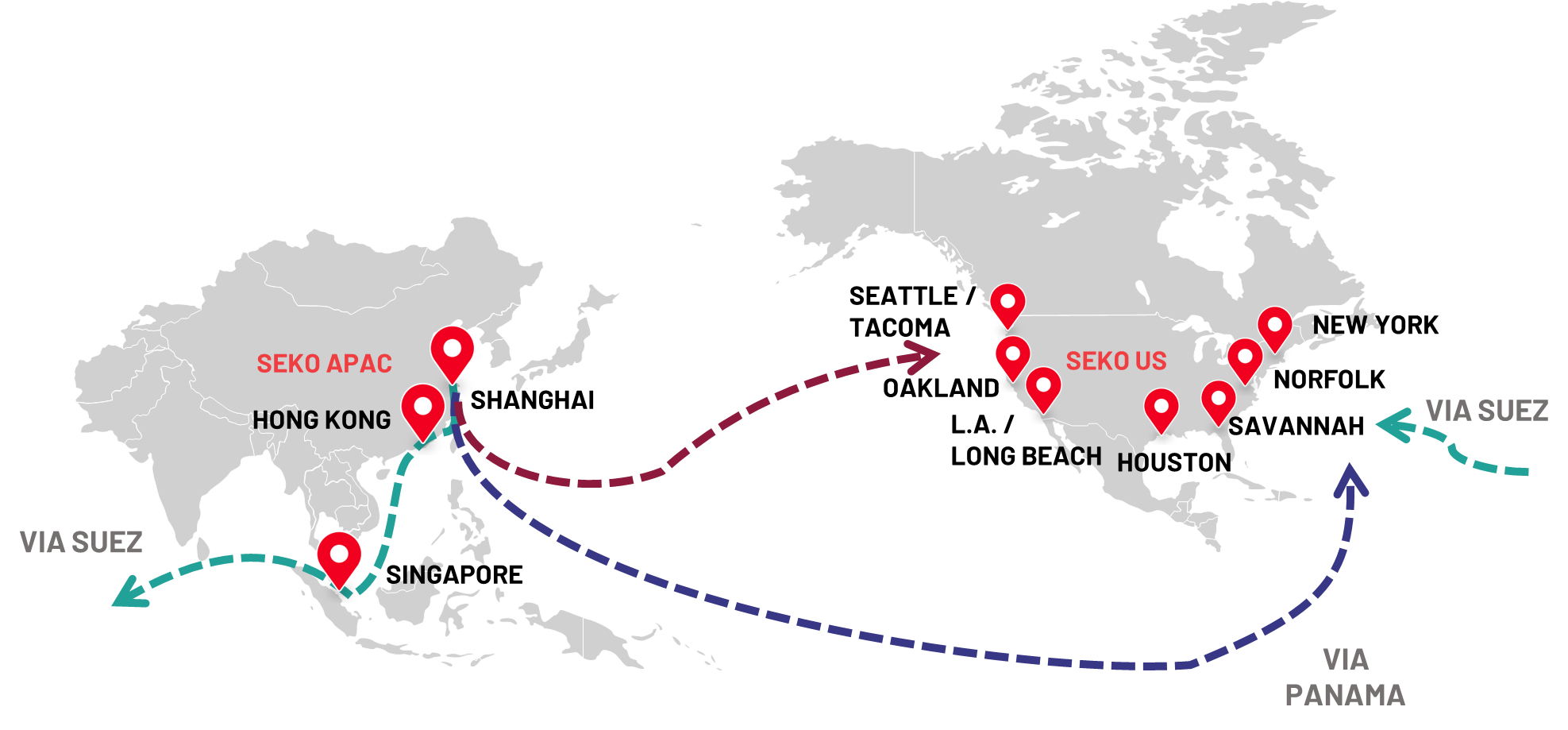
Key Routing Options for Asia-North America Cargo
- Asia to US West Coast (Direct) — The fastest option for destinations in the Pacific states, with cargo arriving at ports like Los Angeles, Long Beach, Oakland, Seattle, and Tacoma.
- Asia to US East Coast via Panama Canal — Ideal for East Coast and Gulf destinations, avoiding West Coast congestion while serving ports from New York to Houston.
- Asia to US East Coast via Suez Canal — An alternative routing that can offer competitive transit times for certain origin-destination pairs, particularly from South and Southeast Asia.
Major Asian Origin Ports
Asian ports serve as the origin points for Transpacific cargo, with specific ports excelling in different regions. Understanding port capabilities and carrier service patterns helps optimise booking decisions.
| Region | Key Ports |
|---|---|
| North Asia | Busan (South Korea), Yokohama (Japan) |
| Central North China | Xingang (Tianjin), Qingdao, Shanghai, Ningbo |
| South China | Xiamen, Yantian, Shekou, Nansha |
| Taiwan | Kaohsiung |
| Southeast Asia | Singapore, Port Klang, Ho Chi Minh City, Haiphong, Laem Chabang |
Note: Port calls are subject to variations in carrier service strings. Non-direct call ports may be subject to origin arbitrary charges. For Transpacific trade, carriers typically apply rates based on the container gate-in date.
US Destination Ports
US ports are organised into distinct coastal regions, each serving different inland markets and offering various connectivity options for final mile delivery.
| Region | Key Ports |
|---|---|
| Pacific Northwest (PNW) | Seattle and Tacoma serve as primary gateways for cargo destined for the Pacific Northwest, with strong rail connections to inland markets. |
| Pacific Southwest (PSW) | Los Angeles and Long Beach form the largest US port complex, handling the majority of Transpacific cargo with extensive intermodal networks. |
| East Coast | New York, Norfolk, Savannah, Charleston, and Jacksonville serve the eastern seaboard with growing capacity and shorter transit to East Coast consumers. |
| Gulf Coast | Houston, Mobile, and Miami provide alternatives for cargo destined for the southern and central United States. |
Intermodal Options: IPI and RIPI
Understanding intermodal terminology is essential for optimising inland cargo movements. Two key concepts govern how cargo moves from port to final US destination:
Interior Point Intermodal (IPI)
IPI moves cargo from West Coast ports inland via rail or truck using a single bill of lading. This simplifies logistics documentation and provides seamless door-to-door service. Common IPI destinations include Chicago, Memphis, Dallas, and Kansas City.
Reverse Interior Point Intermodal (RIPI)
RIPI involves cargo arriving at East Coast ports and moving inland or westward, often via Panama Canal routing. This approach can help avoid West Coast congestion. Popular RIPI destinations include Chicago, Atlanta, and Charlotte.
Learn more at IPI vs. RIPI: What's the Difference?
Key Operational Considerations
Successfully managing Transpacific shipments requires attention to several critical operational factors:
Contract Validity
TPEB contracts run from 1 May to 30 April of the following year. All surcharges apply throughout the contract period unless otherwise specified.
Rate Structure
Rates are applied based on the container gate-in date. For multiple containers under the same bill of lading, the rate is determined by the last container's gate-in date.
FMC Filing
Filings must be completed before container gate-in. Otherwise, carriers reserve the right to apply tariff rates to the shipment.
AMS Requirements
Automated Manifest System (AMS) filing is required before vessel departure for all US-bound shipments.
China-US Lane: What's Happening Right Now
China remains the dominant origin market on this trade lane, and conditions on the ground have been unusually dynamic through the back half of 2026. A run of successive typhoons (Bavi, Noul, Dolphin and Saudel) disrupted operations at Shanghai and Ningbo for a cumulative 180+ hours since July, well above the 39-48 hours logged during the comparable 2025 season. The good news: congestion is easing. Anchored capacity globally has receded from a mid-August peak of 4.3 million TEU to 3.92 million TEU, and Shanghai set an all-time single-day throughput record of 203,881 TEU on 1 August, underscoring that this is a weather-driven disruption rather than a structural one.
Check China to USA Shipping SOP
Unlike Asia-Europe routings, Transpacific schedules aren't affected by Cape of Good Hope diversions, so peak-season timing here hasn't shifted—if anything, strong booking volumes and vessel delays have pushed US East Coast freight rates to their highest levels since the 2021-2022 peak. Shippers should also plan around China's Golden Week holiday (1-7 October): carrier capacity management across Weeks 39-43 is expected to remove a significant share of available sailings, with Shanghai, Qingdao and Ningbo the most exposed origin ports.
Read our full breakdown of current port conditions, Golden Week capacity impacts, and the Suez Canal-driven capacity outlook for 2027 for the complete picture before you finalise Q4 bookings.
US-China Tariffs: The 2026 Picture
Tariff policy on China-origin goods has moved through several distinct phases in 2026, and it's worth understanding how we got to today's rates. Following the IEEPA-based “reciprocal tariff” framework that pushed rates as high as 145% in 2025, a Supreme Court ruling on 20 February 2026 ound that IEEPA does not authorise the President to impose tariffs—striking down that entire framework. The administration responded with a 10% global baseline tariff under Section 122 of the Trade Act as a bridge measure, which itself expired on 24 July 2026 and was replaced the same day by a new Section 301 “forced labour” tariff of 12.5% on Chinese-origin goods.
The result: combined effective rates on most general Chinese goods now sit in the region of 35-37.5% (the new 12.5% base plus the original 25% Section 301 duties dating to 2018-2019), while targeted categories run far higher—electric vehicles, solar cells, semiconductors, steel and lithium-ion batteries can all face combined rates well above 50%, in some cases exceeding 100%. Unlike the now-defunct IEEPA tariffs, Section 301 duties don't expire or require renewal, and a separate Section 301 “excess capacity” investigation opened in March 2026 could push China-specific rates higher still before year-end.
Meanwhile, the broader capacity picture has shifted too: the global containership orderbook has climbed to a record 14.84 million TEU—43.1% of the existing active fleet—pointing toward looser vessel supply from 2027 onward even as near-term space stays tight heading into peak season and Golden Week.
Given how quickly this has moved, always confirm the current rate for your specific HS code with your customs broker or freight forwarder before finalising pricing. SEKO keeps a dedicated US Trade Tariffs 2026 resource updated as the situation develops.
Whatever the tariff environment, SEKO Logistics can help you build a resilient Transpacific strategy. Our established presence across major Asian origin ports—from Hong Kong and Shanghai and Singapore and Ho Chi Minh Port—combined with our extensive US network spanning over 40 locations, positions us to deliver seamless door-to-door Transpacific solutions. Whether you require direct West Coast routing for speed, all-water Panama Canal service for cost efficiency, or Interior Point Intermodal connections to inland destinations like Chicago, Memphis, or Dallas, our ocean freight specialists will design the optimal solution for your supply chain.
Build Resilience Into Your Supply Chain
Contact SEKO Logistics today to discuss your Transpacific shipping requirements. Our team will provide a comprehensive assessment of your current routing, identify cost-saving opportunities, and develop a strategic shipping plan that accounts for today's tariff structure while building resilience into your supply chain for whatever comes next.