China Golden Week 2026 will create a major planning challenge for global importers, exporters, eCommerce brands, retailers, manufacturers and B2B traders moving goods through mainland China, Hong Kong and wider Asia-Pacific trade lanes.
In 2026, China’s National Day Golden Week runs from October 1 to October 7, with adjusted working days on September 20 and October 10. The Mid-Autumn Festival falls separately from September 25 to September 27, creating two closely spaced holiday periods that will compress production, export handovers and freight planning into a narrow window before October.
For global traders, the message is clear: ship early, book capacity ahead of peak demand, confirm documentation before factory closures and build contingency options across ocean, air, trucking and warehousing.
What Is China Golden Week?
Golden Week marks China’s National Day holiday, commemorating the founding of the People’s Republic of China on October 1, 1949. It is one of China’s most important annual holiday periods and one of the most disruptive periods for international supply chains.
During Golden Week, many factories, offices, warehouses, banks, customs-related services and domestic logistics providers operate at reduced levels or close completely. While large ports and airports may continue limited operations, staffing, trucking availability, documentation support and cargo handover capacity often become constrained.
For companies sourcing from China or routing freight through China, Golden Week is not just a holiday. It is a predictable logistics event that can affect purchase order timing, production schedules, supplier communication, container availability, sailing schedules, air freight uplift, warehouse space and final-mile delivery commitments.
Why Golden Week 2026 Requires Early Supply Chain Planning
Golden Week 2026 is especially important for logistics planning because it follows shortly after the Mid-Autumn Festival holiday. Although the two holidays are separate in 2026, they sit close together on the calendar, creating a condensed late-September shipping window.
Key 2026 Holiday Dates for Traders
- September 20, 2026: Adjusted working day before the late-September holiday period.
- September 25-27, 2026: Mid-Autumn Festival holiday.
- September 28-30, 2026: Critical final working window before Golden Week.
- October 1-7, 2026: China National Day Golden Week holiday.
- October 8-16, 2026: Expected recovery period as factories, carriers, warehouses and trucking providers clear backlogs.
- October 10, 2026: Adjusted working day after Golden Week.
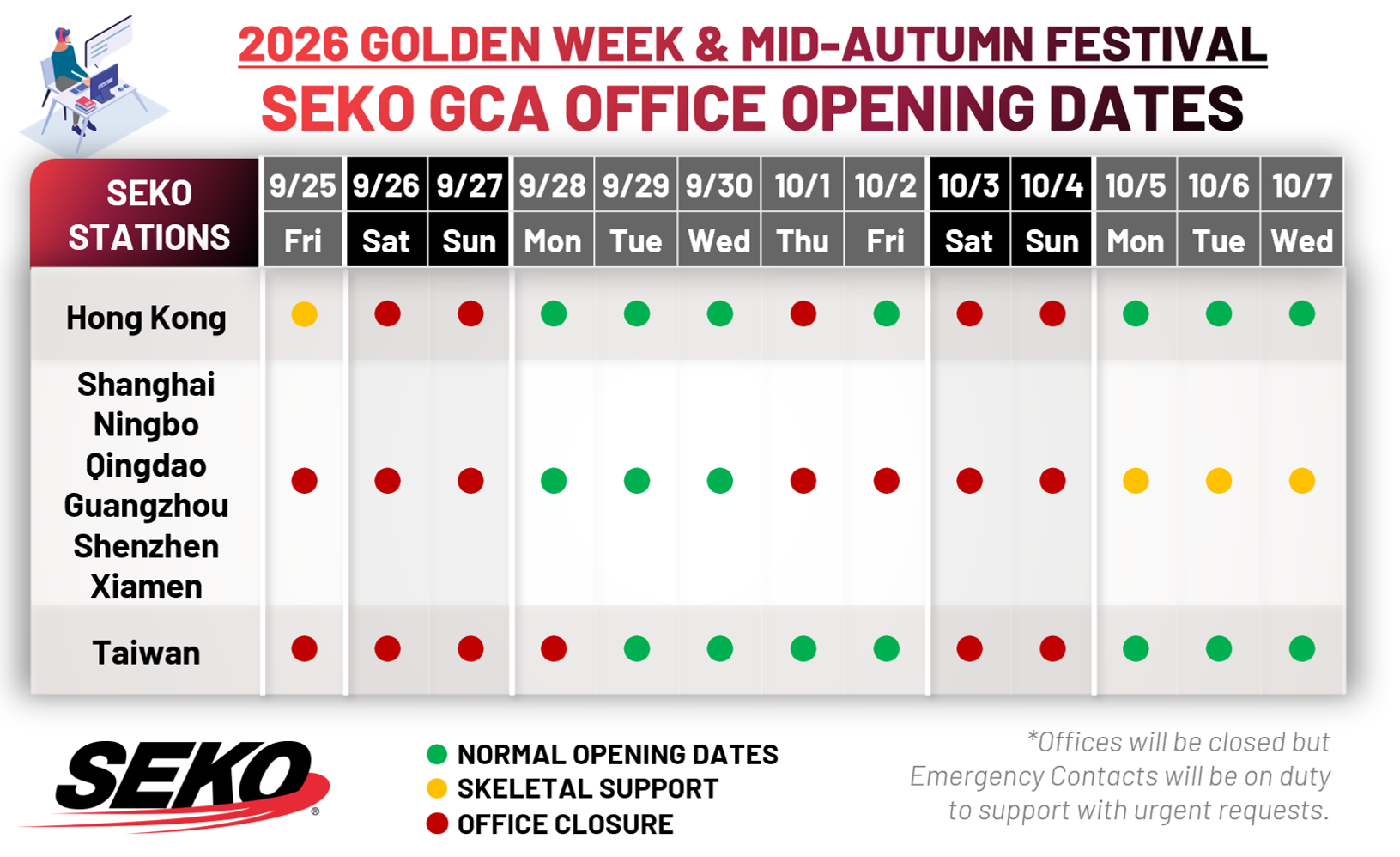
Source: english.www.gov.cn, GovHK
This structure means suppliers may push to complete production and cargo handovers before September 25, while buyers and logistics teams will have only a short window between September 28 and September 30 to resolve documentation, booking, customs and dispatch issues before the National Day shutdown begins.
Expected Golden Week 2026 Supply Chain Disruptions
1. Factory Closures and Production Slowdowns
Many factories in mainland China are expected to close or reduce operations during Golden Week. Some suppliers may also slow production before the holiday as workers travel, management teams finalize orders and factories prepare for temporary shutdown.
Global traders should confirm production completion dates, quality inspection schedules and cargo ready dates well before the final week of September. Orders that are not ready before the holiday may not move until after operations resume in October.
2. Ocean Freight Capacity Pressure and Blank Sailings
Ocean freight demand surges ahead of Golden Week as exporters rush to move cargo before holiday cutoffs. Across Far East Asia–Europe and Mediterranean (FEWB) trades between Weeks 39 and 43, major carrier alliances are executing extensive blank sailings and port omission programs.
Confirmed blank sailings from Ocean Alliance (~78,000 TEU), MSC (~62,000 TEU), and Gemini (~53,000 TEU) account for approximately 193,000 TEU of removed capacity. Combined with operational disruptions such as Premier Alliance's FP2 service omission at Shanghai (~90,000 TEU operational impact), the total capacity affected reaches roughly 283,000 TEU. Week 41 is projected to be the most capacity-constrained period.
Export loading pressure is concentrated heavily at Shanghai and Ningbo, alongside Qingdao, Xiamen, Shenzhen, Yantian, and Busan. In Europe, downstream disruption risk is highest across Northern European gateways (Rotterdam, Hamburg, Antwerp, London Gateway) and Western Mediterranean hubs (Valencia, Barcelona, Genoa, Fos).

Wallace Wong
Regional Ocean Freight Manager, Asia Pacific Region
"Carriers are staying very disciplined this Golden Week, pulling capacity early to keep vessel load factors healthy. Across blank sailings and key port omissions, we’re looking at over 280,000 TEU of total operational impact across the Asia–Europe trade. If you're moving cargo out of Shanghai or Ningbo, you will feel the squeeze, especially around Week 41. My direct advice to shippers is simple: don’t wait until the last minute. Lock in your vessel space weeks ahead, stay flexible on routing, and communicate early to keep your goods from getting rolled."Factors Influencing Capacity Adjustments During Golden Week
- Seasonal Demand Patterns: Expected fluctuations in export volumes during the Golden Week holiday period may lead carriers to adjust network capacity and sailing schedules.
- Vessel Utilization Optimization: Carriers may seek to align available capacity with anticipated cargo demand to maintain efficient network operations.
- Network Balance & Capacity Planning: Schedule adjustments can help carriers manage service offerings in line with evolving market conditions and cargo flows.
- Equipment Positioning: Capacity changes may support the repositioning of containers and equipment across key origin and destination markets.
- Schedule Reliability: Network adjustments can assist in reducing operational disruptions, improving schedule consistency, and minimizing vessel bunching.
- Post-Holiday Network Readiness: Capacity planning may help carriers prepare for anticipated cargo recovery following the Golden Week holiday period.
3. Air Freight Tightening
Air freight often becomes a pressure-release option when ocean freight schedules are missed. As a result, urgent shipments, high-value goods, eCommerce inventory, product launches and spare parts may compete for limited uplift before and immediately after Golden Week.
Importers and exporters should identify priority SKUs, pre-clear commercial invoices and packing lists, and discuss air freight allocations with SEKO before the late-September peak.
4. Trucking and Inland Transport Constraints
Trucking availability can tighten before Golden Week as drivers return home, domestic transport demand rises and factories rush to deliver cargo to ports, airports and warehouses. Inland container moves, cross-border trucking and pickup appointments may require earlier confirmation.
Businesses should avoid last-minute cargo handovers during September 28-30 where possible, as this short working window may become heavily congested.
5. Customs, Documentation and Banking Delays
Customs-related processing, documentation support, banks and administrative offices may operate with reduced staffing or close during the holiday. Missing or inaccurate paperwork can delay cargo until after the holiday period.
To reduce risk, traders should complete commercial invoices, packing lists, HS codes, certificates of origin, licenses and payment requirements before the final pre-holiday week.
6. Post-Holiday Backlogs
The disruption does not end on October 7. After Golden Week, suppliers, warehouses, carriers and trucking providers need time to restart operations and clear accumulated cargo. Backlogs may continue into mid-October, especially for shipments delayed during the final September window.
Golden Week 2026 Planning Timeline for Importers and Exporters
10-12 Weeks Before Golden Week: July 2026
- Review historical China shipment volumes and identify products with October delivery deadlines.
- Confirm supplier production schedules and holiday closure dates.
- Forecast ocean, air and multimodal freight needs with SEKO.
- Identify inventory that should move before the September holiday compression period.
⚠️ Anticipating Peak Typhoon Disruptions?
July through October marks the height of the Pacific typhoon season, directly overlapping with the pre-Golden Week shipping crunch. Leverage SEKO's boots-on-the-ground local expertise across major APAC hubs to monitor extreme weather threats, port closures, and freight delays before they impact your Q4 inventory.
Check Asia-Pacific Live Supply Chain Status8 Weeks Before Golden Week: Early August 2026
- Lock in critical purchase orders and supplier production milestones.
- Prioritize SKUs by revenue impact, customer commitment and delivery urgency.
- Review alternative ports, airports and inland routing options.
- Discuss capacity planning for ocean freight, air freight, warehousing and trucking.
6 Weeks Before Golden Week: Mid-August 2026
- Begin booking ocean freight for priority cargo.
- Confirm container equipment requirements and origin pickup windows.
- Validate documentation requirements for destination customs clearance.
- Align internal sales, procurement and customer service teams on realistic delivery timelines.
4 Weeks Before Golden Week: Early September 2026
- Finalize cargo ready dates with suppliers.
- Secure bookings for shipments that must depart before Golden Week.
- Prepare contingency plans for urgent air freight or partial shipments.
- Confirm warehouse receiving capacity at origin and destination.
2 Weeks Before Golden Week: Mid-September 2026
- Complete commercial invoices, packing lists, certificates and other required documents.
- Confirm port cutoffs, CY cutoffs, CFS cutoffs and airport tender deadlines.
- Communicate delivery expectations to customers and distributors.
- Reduce non-essential shipment changes to avoid last-minute delays.
Final Working Window: September 28-30, 2026
- Focus only on shipments that are ready, documented and confirmed.
- Avoid relying on last-minute pickups unless capacity has already been secured.
- Escalate urgent shipments to your SEKO representative immediately.
- Prepare for limited supplier response times once Golden Week begins.
Post-Golden Week Recovery: October 8-16, 2026
- Monitor supplier restart dates and revised cargo ready timelines.
- Expect backlogs in trucking, warehouse handling and export processing.
- Review rolled bookings, missed cutoffs and revised ETD/ETA schedules.
- Update customers with realistic post-holiday delivery expectations.
Prepare Your Supply Chain for October
Mode-by-Mode Logistics Strategy for Golden Week 2026
Ocean Freight Strategy
- Book priority shipments 4-6 weeks before Golden Week where possible.
- Consider alternative ports if your primary gateway becomes congested.
- Monitor blank sailings, port cutoffs and equipment availability.
- Use consolidation planning to reduce last-minute LCL and CFS pressure.
- Build buffer time into destination delivery commitments.
Air Freight Strategy
- Reserve air freight for high-value, time-sensitive or launch-critical cargo.
- Confirm airport options across mainland China, Hong Kong and nearby Asia-Pacific hubs.
- Prepare documents early to avoid missing uplift windows.
- Split shipments by priority if full order movement is not possible.
Trucking and Cross-Border Strategy
- Pre-book pickup appointments before late September.
- Confirm driver availability for inland and cross-border moves.
- Avoid scheduling non-critical handovers during September 28-30.
- Keep suppliers aligned on warehouse receiving hours and cargo loading readiness.
Warehousing and Inventory Strategy
- Position buffer stock in destination or regional distribution centers before the holiday.
- Use bonded warehousing or free trade zone options where appropriate.
- Prepare for higher inbound volume immediately before and after Golden Week.
- Segment inventory by urgent customer orders, replenishment stock and promotional goods.
Customs and Compliance Strategy
- Review HS codes, product descriptions and declared values before shipment.
- Ensure certificates, permits and destination-specific documents are complete.
- Confirm payment, tax and banking arrangements before offices reduce operations.
- Use digital visibility tools to track exceptions and avoid manual follow-up delays.
Build Your Golden Week Logistics Plan
Golden Week 2026 Risk Checklist for Global Traders
Use this checklist if your business imports from China, exports to China, sells through global marketplaces, manages retail replenishment, or relies on China-origin components.
- Supplier readiness: Have factories confirmed production completion before the holiday?
- Cargo readiness: Are goods packed, inspected and ready for pickup before cutoffs?
- Booking confirmation: Are ocean or air bookings confirmed, not just requested?
- Documentation: Are invoices, packing lists, customs codes and certificates complete?
- Customer communication: Have sales teams updated buyers on possible delays?
- Inventory buffer: Is safety stock positioned before late September?
- Alternative routing: Are backup ports, airports or modes available?
- Visibility: Can your team track shipment milestones and exceptions in real time?
Industries Most Exposed to Golden Week 2026 Delays
While Golden Week affects almost every China-linked supply chain, some industries face higher risk because of tight launch windows, seasonal demand or complex supplier networks.
- Retail and consumer goods: Holiday-season inventory must move before late September to avoid Q4 stockouts.
- eCommerce and marketplaces: Fast-moving SKUs may require pre-positioned stock and air freight backup.
- Technology and electronics: Component delays can affect downstream assembly and product launches.
- Automotive and industrial manufacturing: Parts shortages may disrupt production planning outside China.
- Healthcare and life sciences: Time-sensitive and regulated shipments require early documentation checks.
- Fashion and lifestyle brands: Seasonal collections need strict cutoff management and contingency routing.
How SEKO Helps Global Traders Navigate Golden Week 2026
SEKO Logistics supports global traders with integrated freight forwarding, contract logistics, eCommerce logistics, customs support, visibility tools and supply chain solutions across Asia-Pacific and global trade lanes.
SEKO Golden Week Support Includes:
- Pre-holiday freight planning for ocean, air, road and multimodal shipments.
- Capacity guidance to help prioritize critical cargo before peak demand.
- Alternative routing options through key Asia-Pacific gateways.
- Origin and destination warehousing to support inventory positioning.
- Customs and documentation coordination to reduce preventable delays.
- Real-time shipment visibility to help teams manage exceptions quickly.
- Post-holiday recovery support for backlogs, rolled cargo and revised delivery timelines.
Whether you are moving full container loads, LCL shipments, urgent air freight, eCommerce inventory, retail replenishment or industrial components, SEKO can help you build a Golden Week logistics plan that protects delivery performance and customer commitments.
Recommended Next Steps
- Map your China-origin shipments due to move between mid-September and mid-October 2026.
- Confirm supplier holiday schedules and cargo ready dates as early as possible.
- Book priority freight early, especially for ocean freight and urgent air freight.
- Prepare documentation before the final September window to avoid preventable delays.
- Contact SEKO to review capacity, routing, warehousing and contingency plans.
Ready to protect your supply chain before China Golden Week 2026? Contact SEKO Logistics at hello@sekologistics.com or speak with your dedicated SEKO representative to build a customized Golden Week freight and inventory strategy.
Frequently Asked Questions About China Golden Week 2026
When is China Golden Week 2026?
China National Day Golden Week 2026 runs from October 1 to October 7, 2026. Adjusted working days are scheduled for September 20 and October 10.
Is Mid-Autumn Festival combined with Golden Week in 2026?
No. In 2026, Mid-Autumn Festival runs from September 25 to September 27, before National Day Golden Week. This creates two closely spaced holiday periods rather than one combined eight-day break.
Will ports and airports in China close during Golden Week?
Major ports and airports may continue operating, but capacity can be constrained by reduced staffing, limited trucking availability, supplier closures, documentation delays and increased pre-holiday cargo volumes.
How long does Golden Week disruption usually last?
The most visible disruption occurs before and during the holiday, but recovery can continue for one to two weeks afterward as suppliers, warehouses, carriers and trucking providers clear accumulated backlogs.
What should importers do first?
Importers should identify priority cargo, confirm supplier production dates, secure bookings, prepare customs documentation and communicate realistic delivery timelines to customers before late September.